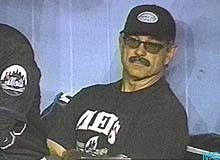
Jonah Keri + Rob Dibble = "What?"

Jonah Keri takes on the question of "Are the Red Sox a dynasty"?
It's a too-wordy article, but it does ask a good question. Basically, Keri compares the current Red Sox to two groups: teams that were actual dynasties (like the Big Red Machine) vs. teams that approached dynasty level (like the '86 Mets).
Now, I have a number of qualms about his method for classifying "approaching dynasty" teams - he highlights five one-year wonderteams (like the 1990 Reds, who didn't make the playoffs for any of the three years before or after their WS title, which, I think, precludes them from dynasty consideration. I might've chosen the late-80s A's as potential dynasties. Actually, it's a crime that he makes no mention of the late-80s and early-90s Blue Jays, who won four division titles and two WS in a five-year span.
Here's some stuff in here that merits mention:
"There's too much movement now," former Reds reliever Rob Dibble says. "Chemistry is a big deal. You need to come up with the same guys, stay with them, get to know their tendencies and their inside jokes. Otherwise, it doesn't work."
I suggest that Reds' GM Wayne Krivsky immediately telephone Rob Dibble and hire him as an inside-joke consultant. Obviously, the Reds' recent lack of success comes from an extreme dearth of tendency-knowing and inside-joke playing. Man, I loved Rob Dibble growing up, but he's an idiot.
Dibble knows something about the challenge of building a dynasty.
No, he doesn't. You are a moron, Jonah Keri. Rob Dibble knows something about injuring innocent first-grade teachers while throwing a public temper tantrum. The Reds' GM in 1990 (Bob Quinn) knows a lot about that challenge. Jonah, why didn't you interview him? You interviewed Rob Dibble. That's what I call "bad journalism".
In 1990, he was a member of the Cincinnati Reds team that won the World Series. Joined by Randy Myers and Norm Charlton, Dibble helped form the Nasty Boys bullpen, a collection of hard-throwing young relievers who -- along with Barry Larkin, Jose Rijo, Eric Davis and other young stars -- figured to form the nucleus of a Reds team that could reel off multiple championships. It didn't happen. Injuries and bad luck conspired against the team, and management soon took it apart.
Well, we could also consider that it was a team that really wasn't that good at all. In fact, Keri did a series of other articles on failed dynasties where he concludes (correctly) that:Nearly two decades later, it's clear what the Reds' shortfall was: They just weren't all that good. Larkin is a player who deserves a spot in Cooperstown one day, but Davis was the poster boy for those teams, a player with all the talent in the world whose inability to stay healthy eventually sapped his ability. Players such as Duncan, Sabo and Armstrong had career or near-career years in 1990, then soon fell off the map.
And that's where Keri's article turns into a real stretch. There's no real comparison between the 2003-7 Red Sox and the 1990 Reds - because the Red Sox have sustained their success over a span of multiple years. They're not built solely on a few guys having career years. I'm not sure the '03-07 Sox are a dynasty, but they're getting pretty close.
"Once you break a link in the chain, it's never as strong as it once was," Dibble says. "Free agency has ruined the game."
What, Rob? You mean the advent of free agency (circa the 1970s) ruined the game? Yeah, you would know. You were playing in the sandbox when free agency was ruining the game.
Forgive Dibble if he sounds like the lords of the realm who still keep Marvin Miller out of the Hall of Fame.
I won't. It's stupid for Rob to long for a baseball past he never experienced.
It's not that he begrudges players the opportunity to choose their employer and make a healthy living. It's that, as a fan of the game, he misses those Mount Rushmore-level teams of the past, the ones you either respected or hated, but could never ignore.
Here's where Jonah Keri is an idiot. Not seven years ago, the Yankees won four titles in five seasons. That's a dynasty by any definition. In the same article, Keri mentions ten distinct baseball dynasties - over one hundred years, that's about a dynasty a decade. Major-league baseball, though experiencing some degree of parity, is not struggling from a lack of dynasty. Say what you want (and this the fault of your employer, Jonah), there are teams that we can't ignore in baseball today. They're the Yankees and the Red Sox.
Although teams such as the Yankees, Red Sox and Mets pull in and spend more money than their lower-revenue counterparts, bigger dollars haven't translated into the kind of juggernauts that once littered baseball's landscape, teams such as Casey Stengel's Yankees, Branch Rickey's Cardinals and John McGraw's Giants.
The 1996-2000 Yankees did that. The current Red Sox are doing that. Still - he's full of shit when he claims that those teams "littered baseball's landscape" - the three teams he cites are separated by 50 years!
Actually, Dibble was born in 1964, too young to remember any of those teams, barely in middle school when the Big Red Machine was winding down. He might pine for the powerhouse teams of the past, but more because of what he has read and heard than what he has seen with his own eyes.
Finally, some sense.From 2000 to 2006, Major League Baseball crowned seven different champions: the Yankees, Diamondbacks, Angels, Marlins, Red Sox, White Sox and Cardinals.
How many times have I heard that stat? 2397812
Buzz past the Yankees' run to 1995,
Why? Because it disproves your point - that dynasties don't exist in contemporary baseball?
and you find a similar mishmash of teams in the winner's circle -- East Coast, West Coast and in between; big markets and small; expansion teams and old-time clubs. Bud Selig's oft-repeated mantra has come to fruition, for long-suffering White Sox fans, short-suffering Marlins fans and many of moderate suffering. "The most important part of our sport are the two words that I use at owners' meetings," Selig told a University of Wisconsin crowd last year. "Our job is to provide hope and faith -- hope and faith that your team has a chance to win."
Is that his job? Maybe so. If "acting in the best interest of the game" means "trying to make baseball a totally even playing field", I guess he is doing his job. Maybe, in order to accomplish this job, he could just hire Shane Stant to whack all the Red Sox' knees.
I think the job of providing hope and faith falls to the team's ownership. Yes, Orioles fans, unless Bud implements the Tonya Harding approach, you're screwed for the forseeable future.
____________________________________________________________________
For the record, I think baseball's level of parity is just about right. The dynasty-frequency doesn't seem to have changed. Maybe the luxury tax is the best way to go about limiting the absolute power of big-market teams and giving small-market teams a small leg up. It seems better, to me, than a salary cap system, which, to be honest is just too Communist for the American pastime.